OCT4 cooperates with distinct ATP-dependent chromatin remodelers in naïve and primed pluripotent states in human
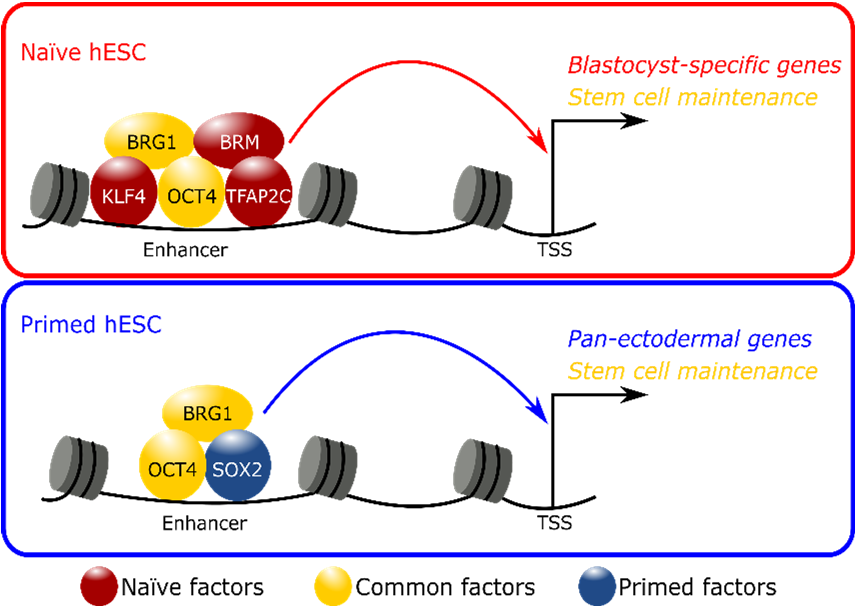
Our paper mapping the interactomes of the master transcription factor OCT4 in naive and primed human embryonic stem cells (hESCs) was published today in Nature Communications. We report that OCT4 cooperates with cell state-specific chromatin modifiers in naive and primed hESCs to promote an open chromatin architecture at blastocyst-associated and pan-ectodermal genes, respectively. This work was a collaboration between our team at WashU, Xin Huang and Jianlong Wang at Columbia University, Cigall Kadoch at the Dana-Farber Cancer Institute, and Rudolf Jaenisch at the Whitehead Institute. The WashU team was spearheaded by Kyoung-mi Park in the Theunissen lab in collaboration with the labs of Bo Zhang, Sabine Dietmann, and Ting Wang.

Probing the signaling requirements for naive human pluripotency

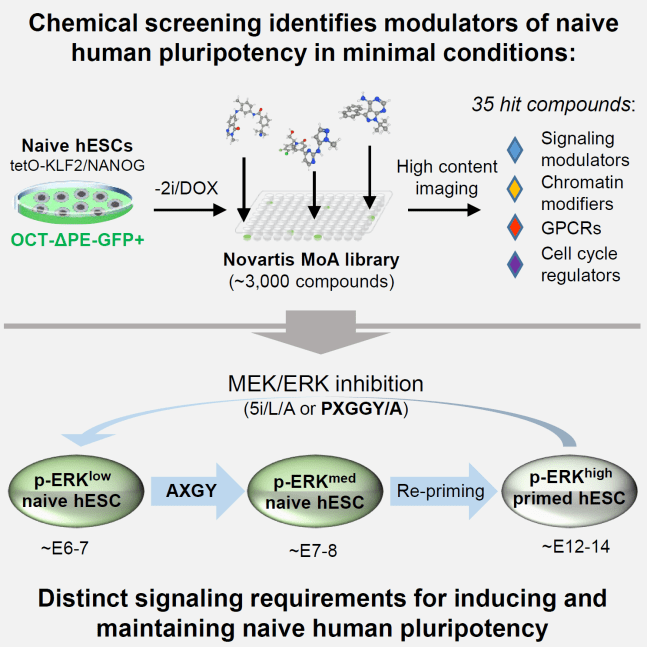
Our paper investigating the signaling requirements for naive human pluripotency by high-throughput chemical screening was published today in Cell Reports. We report that naive hESCs can be maintained by blocking distinct nodes in the FGF signaling pathway and that dual MEK/ERK inhibition promotes efficient primed-to-naive resetting in combination with Activin A. This study was a collaboration between Washington University School of Medicine, the Novartis Institutes for Biomedical Research, and the Whitehead Institute for Biomedical Research

Trophoblast stem cells derived from naive human stem cells

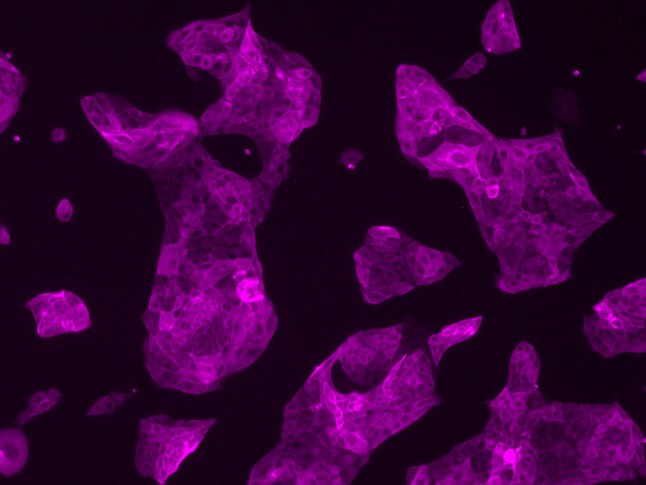
Our paper examining the trophoblast potential of distinct human stem cell states was published today in eLife. We report that naive, but not primed, human pluripotent stem cells (hPSC) can directly differentiate into trophoblast stem cells (TSC). The derivation of TSCs from naïve hPSCs presents a new model system to elucidate early mechanisms  governing placental development and associated pathologies. This study was a collaboration with the Solnica-Krezel, Wang and Kommagani labs at Washington University.

Image of naive hPSC-derived human TSCs stained with a KRT7 antibody by Chen Dong (Theunissen Lab).


Paper on transposable elements and KRAB zinc-finger proteins

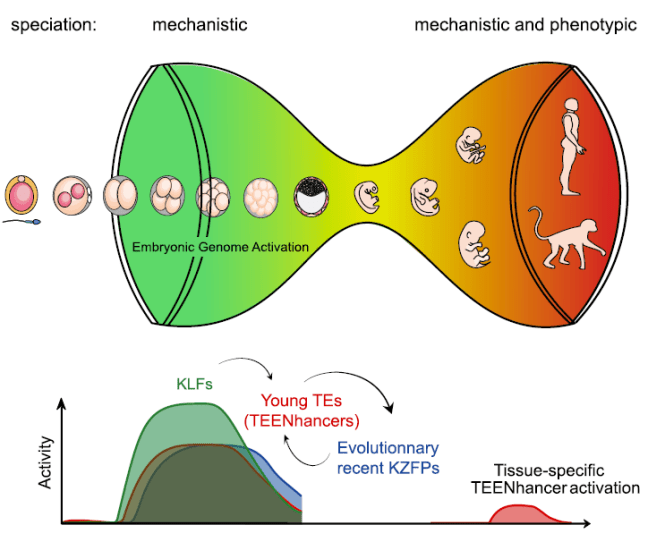
We are excited to contribute to a new study from the Trono laboratory in Lausanne, Switzerland (Pontis et al., Cell Stem Cell, 2019). This work describes how hominoid-specific transposable elements control transcription in naive hESCs and during embryonic genome activation, activating evolutionarily recent KRAB zinc-finger proteins that in turn ‘tame’ the activity of the transposons.