
A fascinating new study by Jose Silva (Thor’s former PhD advisor in Cambridge) and his team at Guangzhou Laboratory reports on the remarkable ability of naive human pluripotent stem cells to spontaneously form blastocyst-like structures (“blastoids”) in 3D suspension culture. These spontaneous blastoids mimic early-stage human blastocysts in terms of structure, size, and transcriptome characteristics and are capable of progressing to post-implantation stages on appropriate matrices, taking advantage of the recent methodology developed by Rowan Karvas and her colleagues in the Theunissen lab. This spontaneous blastoid potential of naive stem cells property is conferred by the glycogen synthase kinase-3 signalling inhibitor IM-12 present in 5iLAF self-renewing naive medium. IM-12 upregulates oxidative phosphorylation-associated genes that underly the capacity of naive stem cells to generate blastoids spontaneously. Starting from day one of self-organization, naive stem cells at the boundary of all 3D aggregates dedifferentiate into E5 embryo-like intermediates. Intermediates co-express SOX2/OCT4 and GATA6 and by day 3 specify trophoblast fate, which coincides with cavitation and blastoid formation. In summary, spontaneous blastoid formation results from 3D culture triggering dedifferentiation of naive stem cells into earlier embryo-like intermediates which are then competent to segregate blastocyst fates. Check out the paper in Nature Communications!
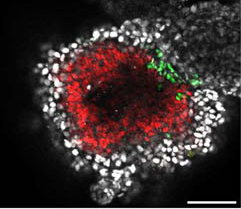
The featured image shows an example of a TBXT-positive primitive streak-like structure in spontaneous blastoids maintained on an optimized 3D matrix until D14 (courtesy of the Silva lab). SOX2 is indicated in red, TBXT in green, and GATA3 in grey.
 Theunissen Lab